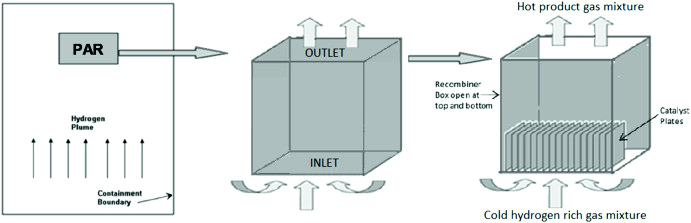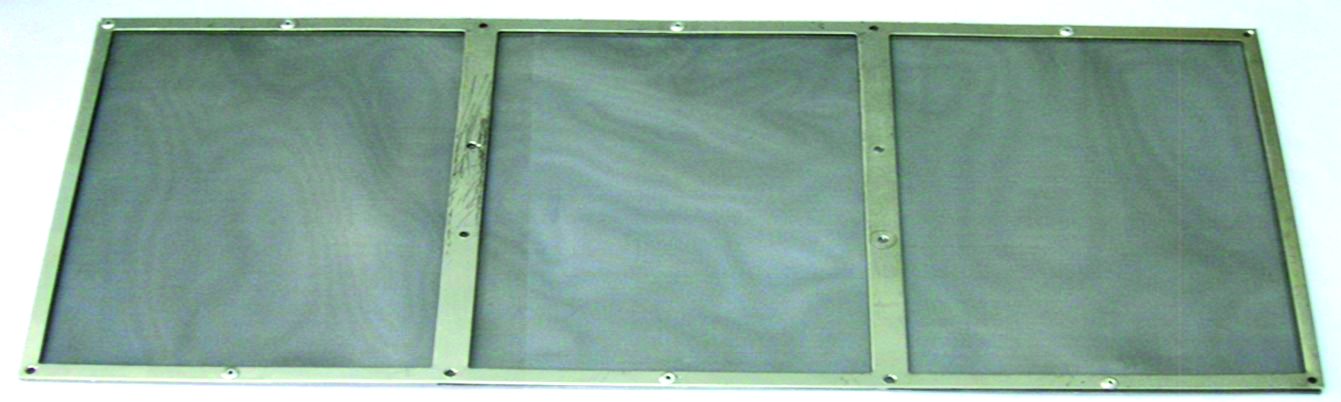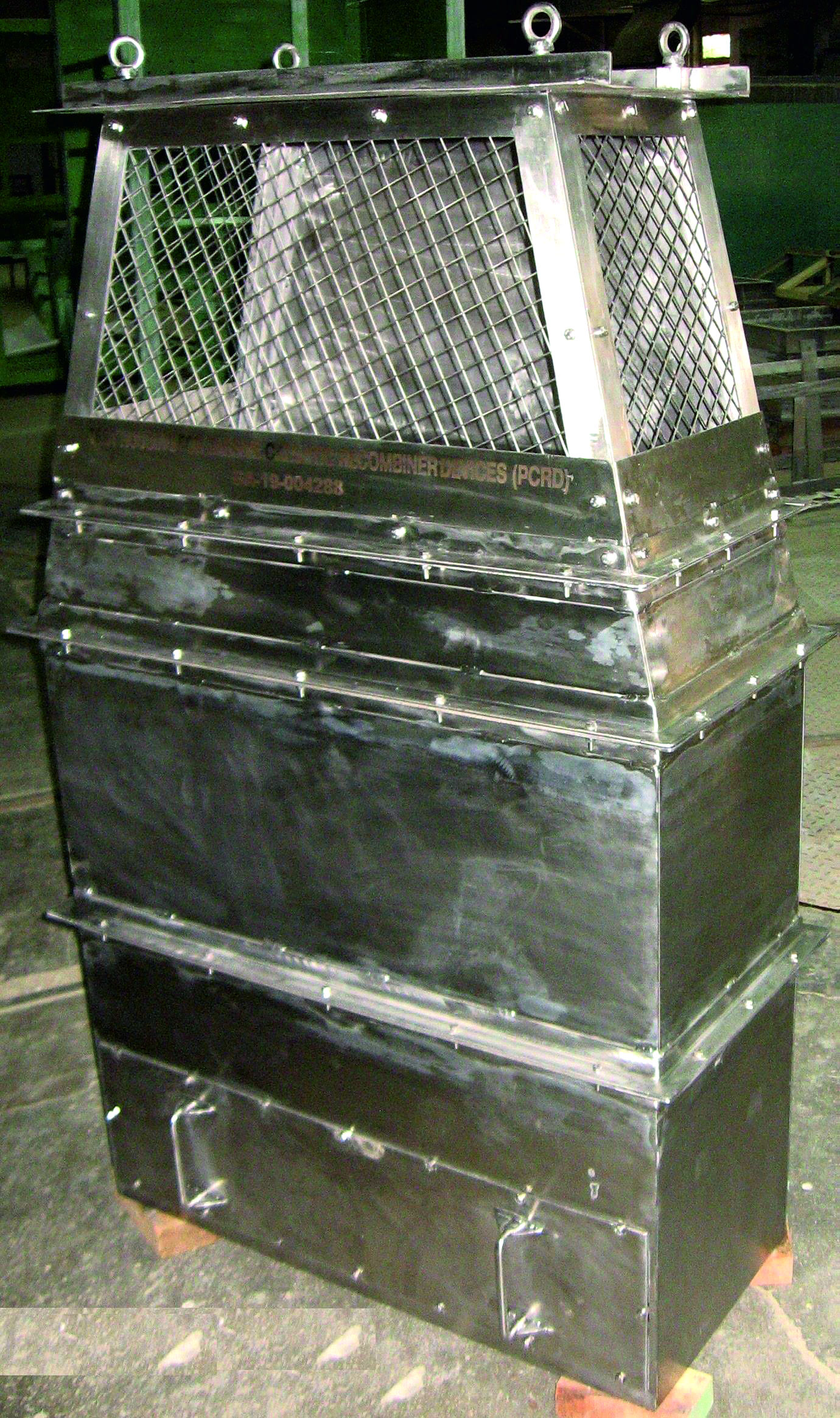
Passive Catalytic Hydrogen Recombiner Device (PCRD) relates to a safety device for removal of hydrogen in a closed containment. It is a a box type device which employs a stainless-steel wire mesh substrate with a coating of catalytically active noble metal (Pt and Pd). Numerous such catalytic plates, in parallel configuration are placed vertically at the bottom of a metal housing. The mixture of hydrogen and air enters through bottom opening and recombines at catalyst surface to form steam. This hot, hydrogen-depleted gas mixture leaves from the top of the box and consequently results in an in-flow of cold, hydrogen-rich gas mixture from the bottom of the box. This makes the devices completely passive. This device finds its applications as a safety devive in nuclear reactors under Loss of Coolant Accident (LOCA) conditions and in other industries using hydrogen gas.
Passive Catalytic Hydrogen Recombiner Device (PCRD) relates to a safety device for removal of hydrogen in a closed containment. It is a a box type device which employs a stainless-steel wire mesh substrate with a coating of catalytically active noble metal (Pt and Pd). Numerous such catalytic plates, in parallel configuration are placed vertically at the bottom of a metal housing. The mixture of hydrogen and air enters through bottom opening and recombines at catalyst surface to form steam. This hot, hydrogen-depleted gas mixture leaves from the top of the box and consequently results in an in-flow of cold, hydrogen-rich gas mixture from the bottom of the box. This makes the devices completely passive. This device finds its applications as a safety device in nuclear reactors under Loss of Coolant Accident (LOCA) conditions and in other industries using hydrogen gas.
Passive Catalytic Hydrogen Recombiner Device (PCRD) relates to a safety device for removal of hydrogen in a closed containment. It is a a box type device which employs a stainless-steel wire mesh substrate with a coating of catalytically active noble metal (Pt and Pd). Numerous such catalytic plates, in parallel configuration are placed vertically at the bottom of a metal housing. The mixture of hydrogen and air enters through bottom opening and recombines at catalyst surface to form steam. This hot, hydrogen-depleted gas mixture leaves from the top of the box and consequently results in an in-flow of cold, hydrogen-rich gas mixture from the bottom of the box. This makes the devices completely passive. This device finds its applications as a safety device in nuclear reactors under Loss of Coolant Accident (LOCA) conditions and in other industries using hydrogen gas.
The device consisting of the modular panels of catalyst bearing panels housed in a recombiner box. The use of stainless steel gauze in these panels as noble metal support economizes on the coated noble metal, improves the adherence of dispersed noble metal, makes the surface abrasion resistant and improves the flow and diffusion of reacting stream through the catalytic strips. The choice and composition of the noble metals and the number of catalyst bearing panels can be varied depending on the specific requirement, giving considerable flexibility to the final design of the recombiner device. A mix of these characteristics makes the device unique. Numerous such catalytic plates, placed in parallel configuration, are arranged vertically at the bottom of a metal housing. The metal housing is designed to promote flow through it with gas mixture entering and leaving through the openings provided at the bottom and top respectively. The gas mixture of hydrogen and air, upon contact with the catalyst surface at the inlet of the box, recombines to form water. The heat of reaction produced at the catalyst walls causes, first the heating of catalyst plates, which subsequently dissipate heat to the surrounding gas mixture. The heated gases, with lower density, rises through the box, thereby establishing strong buoyancy induced convective flow over the catalyst surface. The convective flow of fresh hydrogen-air mixture entering the box is found to improve the catalyst performance significantly.
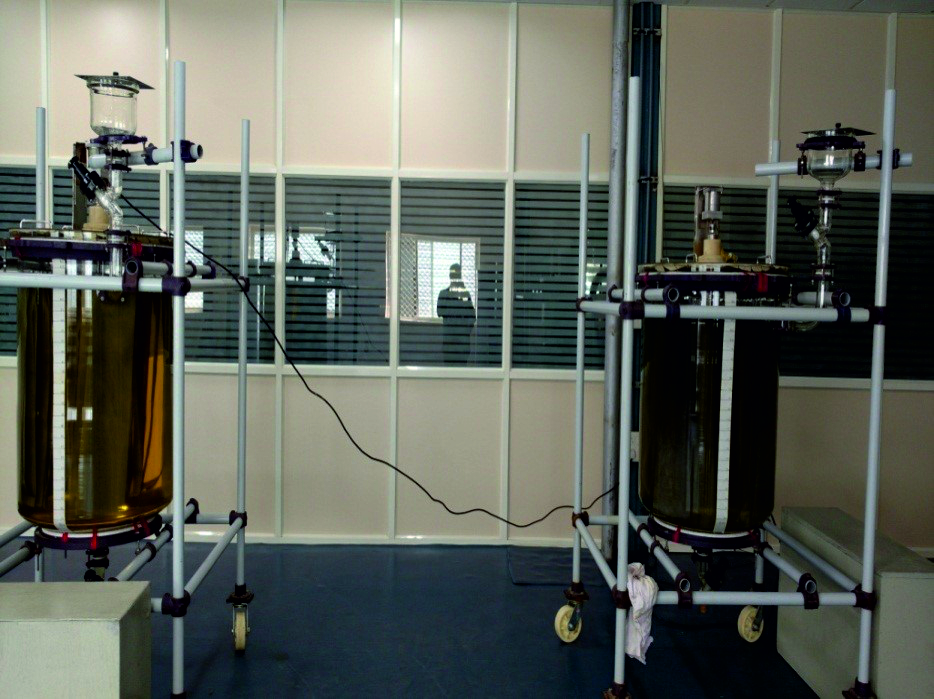
The catalyst synthesis method involves the use of electroless deposition method. Electroless plating of noble metal is a heterogeneous, autocatalytic and redox electrochemical reaction. The reaction occurs on the solid-liquid interface between the noble metal precursors and the reducing agents from the electroplating bath on to the metal substrate surface.
The passive catalytic recombiner device has been indigenously designed and developed in BARC with readily available indigenous components. The function of the Auto-catalytic recombiners is to favour the hydrogen-oxygen chemical reaction so that the reaction takes place at low temperature and concentration. The active catalyst materials include the noble metals platinum or palladium. Passive-catalytic recombiner is considered as “passive” because such a device is self-starting, self-feeding, and requires no external energy.
MATERIALS REQUIRED
INFRASTRUCTURE
A chemical laboratory having baths for electroless deposition as well as chemical etching of wire mesh, Oven for drying and exhaust facility for handling formaldehyde and dilute acid are required.
MATERIAL AVAILABILITY
All raw materials are easily available in local market.
MANPOWER
One chemist (B.Sc. in Chemistry), one laboratory technician (for maintenance of facilities) and one helper (for cutting wire mesh, riveting etc.) are required for the production.