
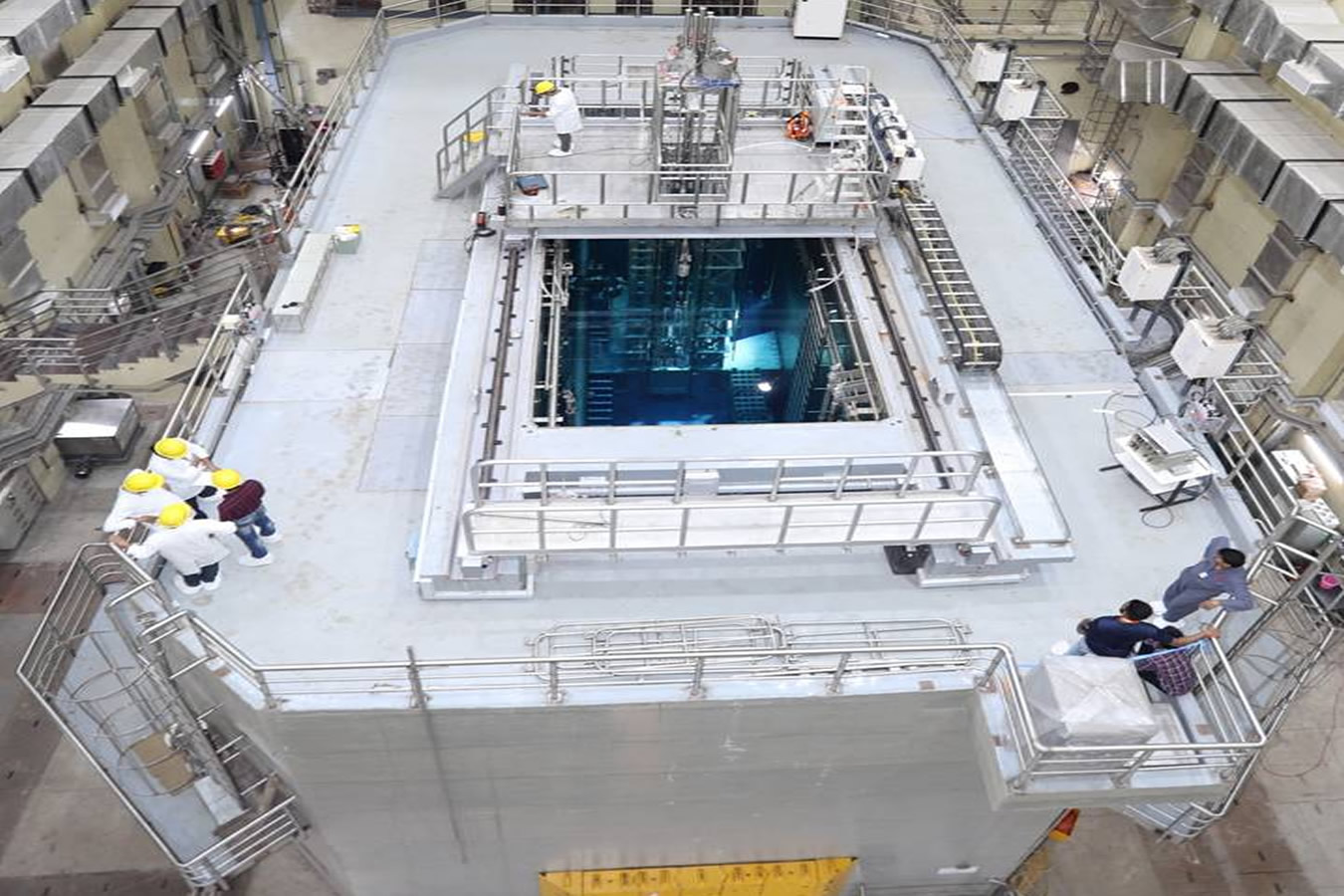
| No. | Item | Description |
|---|---|---|
| 1 | Reactor Type | Swimming pool type/ Thermal Reactor |
| 2 | Date of Criticality | September 10, 2018 |
| 3 | Reactor Power (Th) | 2 MW (Maximum) |
| 4 | Fuel Material | Uranium Silicide (LEU) |
| 5 | Fuel Element | Plates |
| 6 | Fuel Cladding | Aluminium alloy |
| 7 | Core Size | 662 mm x 662 mm x 140 mm; 64 lattice positions |
| 8 | Max Neutron Flux | 6.1X10¹³n/cm2/sec |
| 9 | Moderator | Light water |
| 10 | Coolant | Light water |
| 11 | Reflector |
Beryllium Oxide |
| 12 | Shut off rods / Control Rods |
Hafnium |
| 13 | Uses |
|
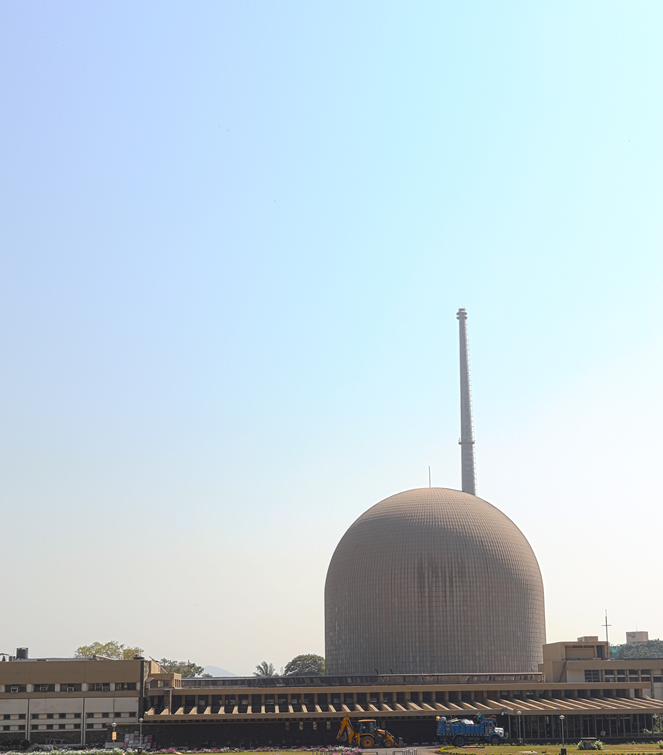
Apsara-U (Apsara- Upgraded) was successfully commissioned and its First Approach to Criticality (FAC) was achieved on 10th September 2018. Indigenously developed Low Enriched Uranium (LEU) fuel in Uranium Silicide form is used in the reactor. Hot water layer concept at the top of pool, which is first of a kind in India, is employed to minimize radiation dose. By virtue of higher neutron flux, Apsara-U will enhance indigenous production of radioisotopes for various societal applications. The reactor will also be used extensively for research in nuclear physics, material science and radiation shielding. |
||
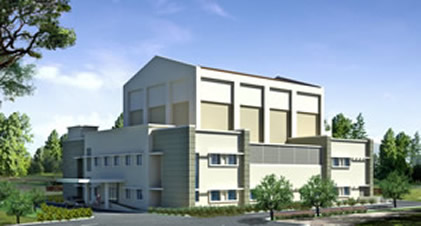
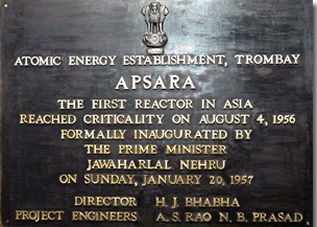
| No. | Item | Description |
|---|---|---|
| 1 | Reactor Type | Swimming pool type/ Thermal Reactor |
| 2 | Date of Criticality | August 4,1956 |
| 3 | Reactor Power (Th) | 1 MW (Maximum) |
| 4 | Fuel Material | Enriched uranium -aluminium alloy |
| 5 | Fuel Element | Plates |
| 6 | Fuel Cladding | Aluminium alloy |
| 7 | Total weight of Fuel | 4.5 kg |
| 8 | Core Size | 560 mm X 560 mm X 615 mm(H) |
| 9 | Max Neutron Flux | 1013n/cm2/sec |
| 10 | Moderator | Light water |
| 11 | Coolant | Light water |
| 12 | Shut off Rods |
Cadmium |
| 13 | Uses |
|
The Apsara Reactor was permanently shutdown in 2010. |
||
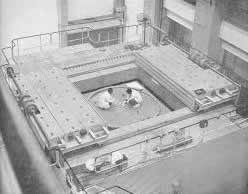
| No. | Item | Description |
|---|---|---|
| 1 | Reactor Type | Vertical Tank Type / Thermal |
| 2 | Date of Criticality | January 14,1961 |
| 3 | Reactor Power (Th) | 100 W (Nominal) |
| 4 | Fuel Material | Natural Uranium Metal |
| 5 | Fuel Element | Rods |
| 6 | Fuel Cladding | Aluminium |
| 7 | Total weight of Fuel | Variable (3.7 T in the first core) |
| 8 | Core Size | 2.29m (D) X 4.35m(H) |
| 9 | Max Neutron Flux | 0.5x10⁸n/cm2/sec |
| 10 | Moderator | Heavy water |
| 11 | Coolant | Heavy water |
| 12 | Shut off Rods |
Cadmium |
| 13 | Uses | Reactor Lattice studies |
| 14 | Year of decommissioning | 1983 |
The CIRUS reactor was commissioned on 10th July 1960. It was built in collaboration with Canada under the leadership of Dr. Homi Jahangir Bhabha. This reactor was extensively used for condensed matter research, using neutron beams extracted from its core. The reactor was also extensively used for material irradiation, fuel testing, neutron activation analysis and production of radioisotopes for application in the fields of medicine, agriculture and industry. CIRUS reactor proved to be an excellent platform for training of engineers and scientists and in understanding the intricacies of managing natural uranium, heavy water, reactor systems which eventually evolved into the Indian pressurized heavy water reactor programme. After 50 years of successful operation, it was decided to permanently shut-down the reactor in December 2010.
| No. | Item | Description |
|---|---|---|
| 1 | Reactor Type | Vertical Tank Type / Thermal Reactor |
| 2 | Date of Criticality | July 10,1960 |
| 3 | Reactor Power (Th) | 40 MW (Maximum) |
| 4 | Fuel Material | Natural Uranium Metal |
| 5 | Fuel Element | Rods |
| 6 | Fuel Cladding | Aluminium |
| 7 | Total weight of Fuel | 10.5 T |
| 8 | Core Size | 2.67m (D) X 3.14m (H) |
| 9 | Max Neutron Flux | 6.5x10¹³n/cm2/sec |
| 10 | Moderator | Heavy water |
| 11 | Coolant | Light water |
| 12 | Shut off Rods |
Boron Cadmium |
| 13 | Uses |
|
| The Reactor was permanently shutdown on 31.12.2010. | ||
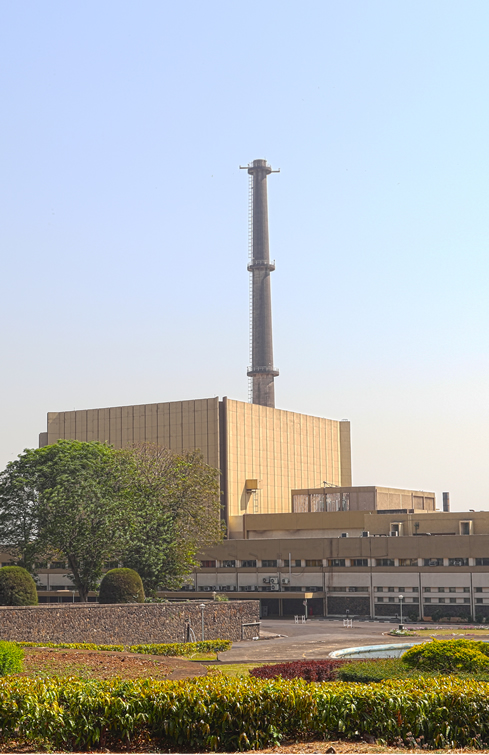
During early 1970s a strong need was felt for building a research reactor with higher neutron flux to meet the growing demand of radioisotopes and advanced research in basic sciences. This led to the setting up of a research reactor at BARC which was named Dhruva by Dr. Giani Zail Singh, the then President of India. Construction of DHRUVA was an important milestone in the development and implementation of indigenous nuclear technology in India. The reactor incorporates several features catering to the requirements of a broad-based multidisciplinary user community as also in the production of radioisotopes of high specific activity. Dhruva has been declared as a National Facility for Neutron Beam Research to cater to the needs of Indian scientific community where scientists from BARC, other units of the Department of Atomic Energy (DAE), universities and national laboratories work under collaborative projects. Many of the collaborations are supported by the University Grants Commission – DAE Consortium for Scientific Research (UGC-DAE-CSR), the Board of Research in Nuclear Sciences (BRNS) and other agencies. At present there are about 40 active projects running under the UGC-DAE-CSR scheme.
| No. | Item | Description |
|---|---|---|
| 1 | Reactor Type | Vertical Tank Type / Thermal Reactor |
| 2 | Date of Criticality | August 8,1985 |
| 3 | Reactor Power (Th) | 100 MW (Maximum) |
| 4 | Fuel Material | Natural Uranium Metal |
| 5 | Fuel Element | Clusters |
| 6 | Fuel Cladding | Aluminium |
| 7 | Total weight of Fuel | 6.35 T |
| 8 | Core Size | 3.72m(D) x 3.87m (H) |
| 9 | Max Neutron Flux | 1.8x10¹⁴n/cm2/sec |
| 10 | Moderator | Heavy water |
| 11 | Coolant | Heavy water |
| 12 | Shut off Rods |
Cadmium |
| 13 | Uses |
|
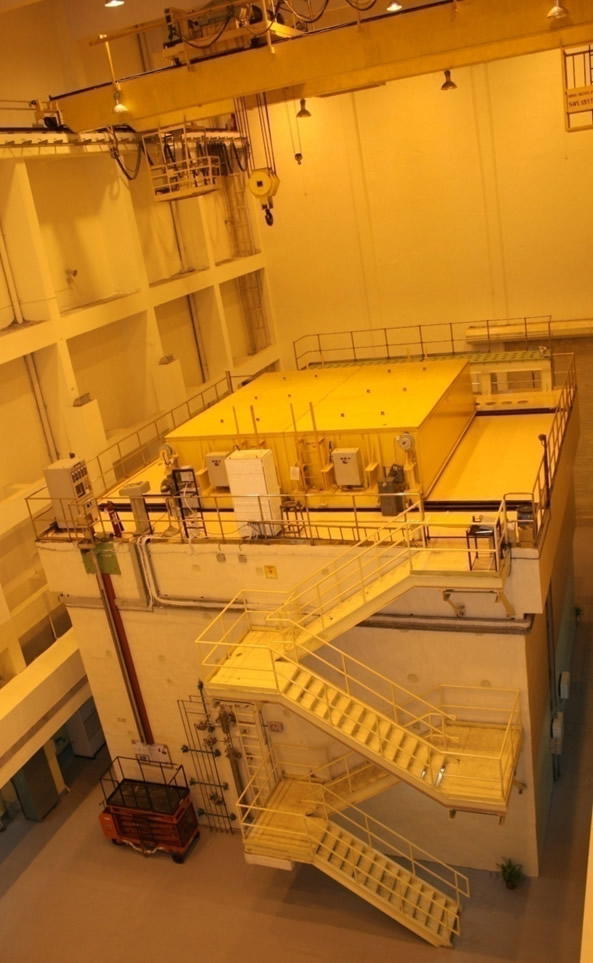
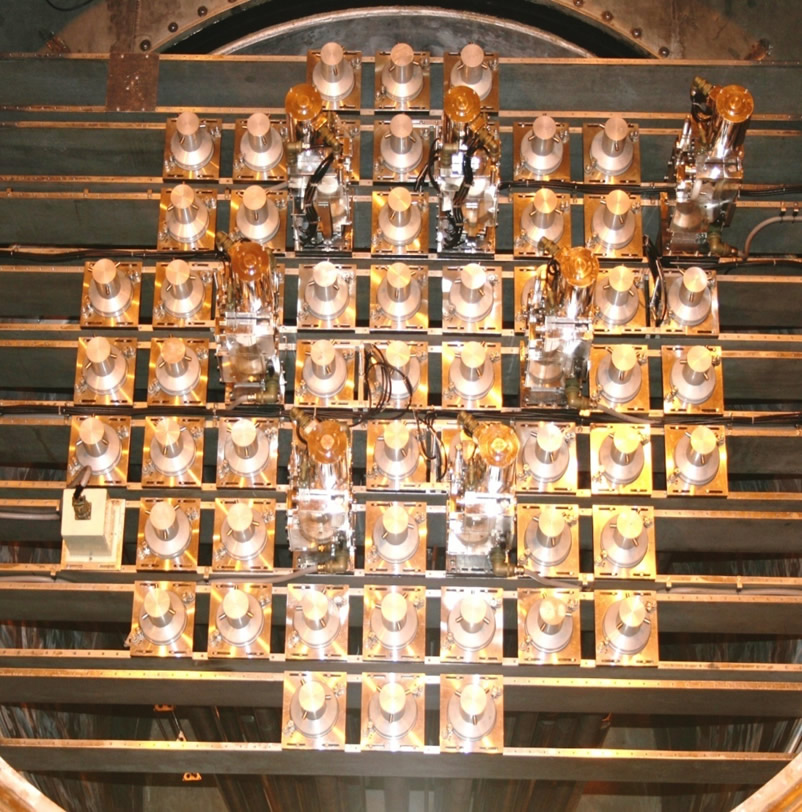
| No. | Item | Description |
|---|---|---|
| 1 | Reactor Type | Vertical Tank Type/Thermal Reactor |
| 2 | Date of Criticality | April 7, 2008 |
| 3 | Nominal Reactor Fission Power | 100 watts |
| 4 | Fuel Material | Natural Uranium Metal |
| 5 | Fuel Element | Clusters |
| 6 | Fuel Cladding | Aluminium |
| 7 | Total Weight of Fuel | 5.0 T |
| 8 | Core Size | 3.3 m (D) x 5.0m (H) |
| 9 | Neutron Flux (Average) | ~108n/cm2/sec |
| 10 | Moderator | Heavy Water |
| 11 | Shut Off Rods | Cadmium |
| 12 | Uses |
|
| 13 | Provision for short duration operation of the reactor at higher power to obtain higher neutron flux of around 109 n/cm2/sec for the development & calibration of self powered neutron detectors. | |